


Redesigning navigation
Simplifying complexity through scalable, accessible, and intuitive navigation.
As part of my role at WorkJam, I led the complete redesign of the platform’s navigation system, rethinking how users discover and interact with the full breadth of our workforce management features.
WorkJam's navigation had become a victim of the platform's own success. As scheduling, communications, task management, and analytics piled on, the existing structure stopped guiding users and started hiding things from them. I led the redesign of the navigation system across web, iOS, and Android. Most of the work wasn't picking what the navigation should look like. It was deciding what it had to absorb, what it had to refuse, and what it had to keep working for across roughly 50 clients with wildly different feature sets.
WorkJam offers a wide range of features: from scheduling to communication to task management. Our existing navigation was overwhelming, burying essential tools and making it hard for users to move fluidly across workflows.
To better understand how users mentally grouped features and expected to navigate through the platform, I conducted card sorting exercises with internal teams and stakeholders. These insights helped shape a clearer and more intuitive information architecture. I then translated these learnings into site maps and navigation wireframes, exploring multiple structural approaches before defining the final scalable framework.

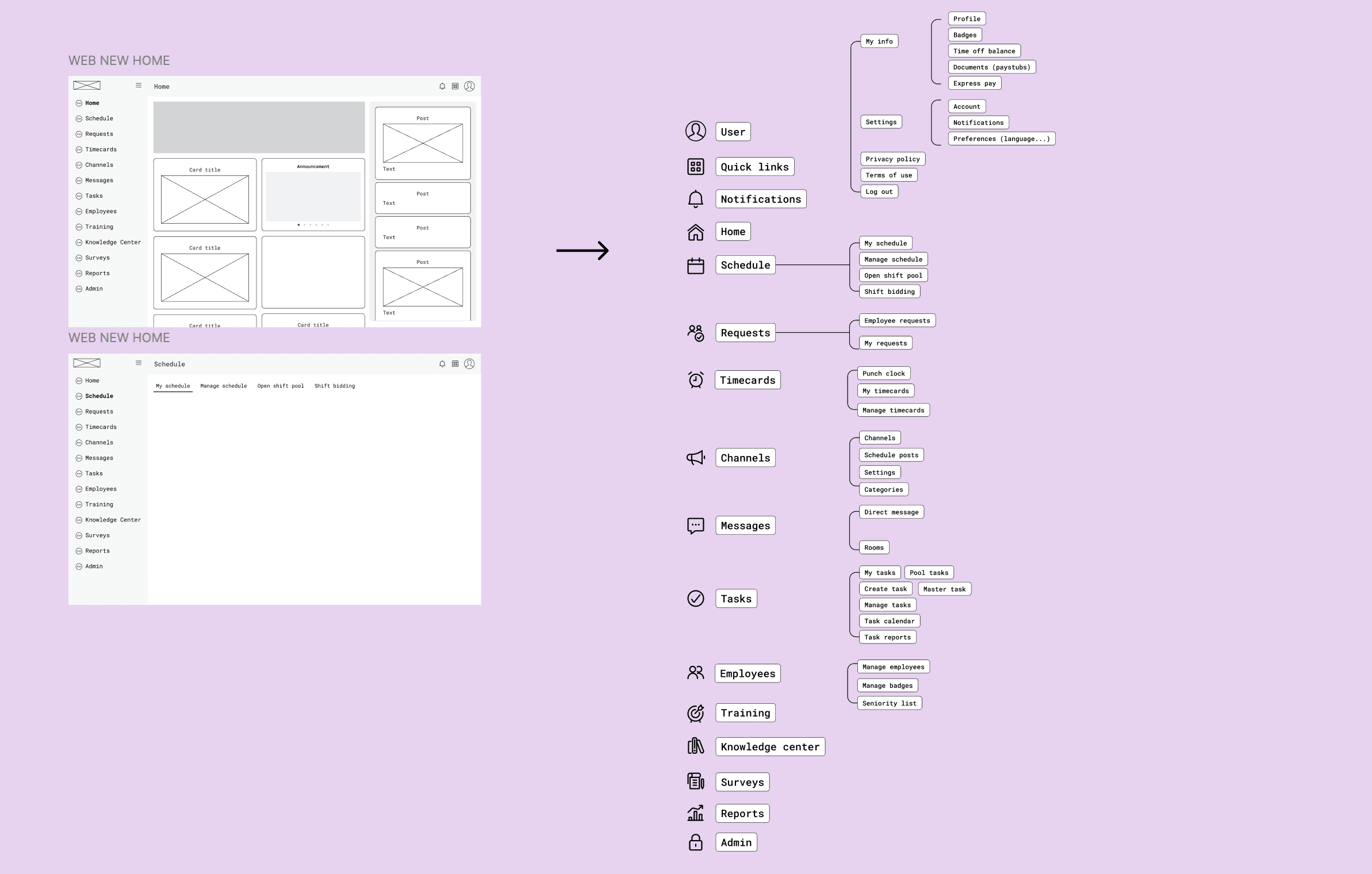
The first real decision was structural: top nav or side nav. Top navigation is more familiar and uses less screen real estate at rest. I argued for side navigation anyway, and the research backed it. Side nav scales vertically and WorkJam's feature surface keeps growing vertically. Top nav would have forced us into nested dropdowns within eighteen months, recreating the exact "where is this buried" problem we were trying to solve. Side nav let us add modules without restructuring.
The version that almost shipped was draggable, users could resize the nav themselves to balance density and screen space. We cut it. Implementation complexity was high, the value was marginal compared to a well-tuned default, and a collapsible nav covered the core use case (more canvas when you need it) without the engineering cost. Draggable was the kind of feature that looks great in a demo and gets used twice. Collapsible was the one users would actually live with.


WCAG compliance, keyboard navigation, screen reader support, contrast…these are entry conditions for shipping a navigation system, not differentiators. I designed against them from the start and worked closely with engineering to keep the implementation honest. Components clearly state their destination and indicate the user's current position because they have to.
“This work gave us a fantastic opportunity to design and implement for accessibility, from the ground up.”

The same applies to responsiveness. The navigation works across desktop, tablet, and mobile. That's the floor, not the ceiling.
This redesign wasn't shipped quietly. I presented it to WorkJam's full client base at WorkJam Days, our annual customer conference, walking ~60 client organizations through the rationale, the structure, and what it meant for the teams already using the platform. Designing a navigation system is one job. Standing in front of the people who'll have to retrain their workforce on it is another.
The redesign was approved relatively cleanly. Migrating every existing feature into it was where the work actually lived. Each module had its own conventions, its own assumptions about where it sat in the hierarchy, its own deep links and entry points. Fitting all of them into the new structure, without breaking existing workflows for clients already in production was months-long coordination effort across teams. The navigation design was a deliverable. The navigation adoption was a project.
The navigation redesign isn't the most visually ambitious thing I've worked on. Most of it is restraint: choosing a structure that absorbs growth instead of fighting it, cutting a feature that looked clever, building an IA that survives tenant variation, and treating accessibility and responsiveness as the price of entry rather than highlights. The work that holds up is rarely the work that shows off.